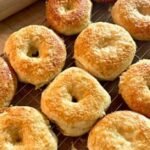
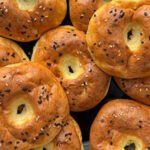
Yields: 8 large bagels
Prep Time: 30 minutes (plus 8-12 hours fermenting)
Cook Time: 20-25 minutes
Total Time: 9-13 hours (mostly hands-off)
Difficulty: Intermediate (Requires an active sourdough starter and some baking experience)
Ingredients
For the Bagel Dough:
-
150g (about ⅔ cup) active, bubbly sourdough starter
-
360g (1 ½ cups) warm water
-
500g (4 cups + 2 tbsp) bread flour
-
15g (2 ½ tsp) fine sea salt
-
30g (2 tbsp) barley malt syrup or honey
For the Poaching Liquid:
-
2 quarts (8 cups) water
-
2 tbsp barley malt syrup (or honey or brown sugar)
-
1 tbsp baking soda
For Topping (Optional):
-
Everything Bagel Seasoning
-
Sesame seeds
-
Poppy seeds
-
Flaky sea salt
Equipment
-
Stand mixer with dough hook (or a strong arm for hand mixing)
-
Kitchen scale (highly recommended for accuracy)
-
Large bowl
-
Bench scraper
-
Large pot or Dutch oven
-
Slotted spoon or spider strainer
-
Parchment-lined baking sheet
Instructions
Day 1: Evening – Mixing & Bulk Fermentation
-
Combine Ingredients: In the bowl of your stand mixer, combine the warm water and active sourdough starter. Whisk until the starter is mostly dissolved. Add the bread flour, salt, and barley malt syrup.
-
Knead the Dough: Using the dough hook attachment, mix on low speed for 2-3 minutes until a shaggy dough forms. Increase the speed to medium and knead for 8-10 minutes. The dough will be quite stiff and should become smooth and pull away from the sides of the bowl. It should pass the “windowpane test” – you should be able to stretch a small piece thinly enough to see light through it without it tearing easily.
-
Bulk Ferment: Place the dough into a lightly oiled large bowl. Cover with a damp cloth or plastic wrap and let it rest at room temperature (70-75°F / 21-24°C) for 8-12 hours, or overnight. The dough is ready when it has roughly doubled in size and is full of air pockets. This long, slow fermentation is key to developing the signature sourdough flavor.
Day 2: Morning – Shaping & Proofing
-
Divide the Dough: Turn the dough out onto a very lightly floured surface. Using your bench scraper, divide the dough into 8 equal pieces (about 115-120g each).
-
Pre-shape: Gently form each piece into a tight ball by pulling the edges down and pinching them together at the bottom. Cover with a towel and let them rest for 15-20 minutes. This relaxes the gluten, making shaping easier.
-
Shape the Bagels: To shape, poke a floured finger through the center of each dough ball. Gently stretch and rotate the dough around your fingers to widen the hole to about 2 inches—it will shrink back as it proofs. Place the shaped bagels on your parchment-lined baking sheet.
-
Second Proof: Cover the shaped bagels with a damp towel or plastic wrap and let them proof for 1-2 hours at room temperature. They won’t double in size, but they should look a little puffy. To test if they’re ready, use the “float test”: drop a bagel into a glass of room-temperature water. If it floats within 10 seconds, it’s ready to boil and bake. If it sinks, let it proof a little longer and test again.
Boiling & Baking
-
Preheat and Prepare: About 30 minutes before the end of the proof, preheat your oven to 425°F (220°C). Bring the 2 quarts of water, barley malt syrup, and baking soda to a rolling boil in a large, wide pot.
-
Poach the Bagels: Gently drop 2-3 bagels at a time into the boiling water (don’t overcrowd the pot). They should float immediately. Poach for 30 seconds, flip them over, and poach for another 30 seconds. A shorter poach (30-60 seconds total) gives a thinner, chewier crust. A longer poach (1-2 minutes per side) gives a thicker, denser crust.
-
Add Toppings: Using your slotted spoon, remove the bagels from the water, letting excess water drip off. Place them back on the parchment-lined baking sheet. While they are still wet and sticky, sprinkle generously with your desired toppings.
-
Bake to Perfection: Bake for 20-25 minutes, rotating the pan halfway through, until the bagels are deeply golden brown, blistered, and firm to the touch.
-
Cool: Transfer the baked bagels to a wire cooling rack. Resist the urge to cut into one immediately! Let them cool for at least 30-60 minutes to allow the crumb to set properly. This is crucial for the perfect chewy texture.
Baker’s Notes & Tips
-
Starter Vitality: Your starter must be active and recently fed (peaking 4-8 hours after feeding) for this recipe to work. A weak starter will lead to dense bagels.
-
Dough Stiffness: This is a stiff, low-hydration dough. Don’t be tempted to add more water; the stiffness is what creates the classic dense, chewy bagel crumb.
-
The Baking Soda Bath: The baking soda in the poaching liquid is non-negotiable. It creates an alkaline environment that is responsible for the classic bagel crust—browning beautifully and developing that distinctive “bagel” flavor.
-
Storage: Once completely cool, store bagels in a paper bag at room temperature for 2-3 days. For longer storage, slice and freeze them for up to 3 months. Toast directly from frozen.
Nutrition Information
-
Serving Size: 1 plain bagel (without toppings)
-
Calories: ~265
-
Total Fat: 1g
-
Saturated Fat: 0g
-
Cholesterol: 0mg
-
Sodium: 590mg
-
Total Carbohydrates: 55g
-
Dietary Fiber: 2g
-
Sugars: 2g
-
Protein: 9g

Hayyat is a talented content writer and digital marketer with expertise in SEO, social media management, and online marketing. She excels at creating impactful, data-driven content to help businesses connect with their target audience and achieve measurable outcomes.