Prep Time: 30 minutes (active)
Total Time: 24-36 hours (including fermentation)
Baking Time: 45 minutes
Difficulty: Medium-High (requires patience and attention to detail)
Yield: 1 magnificent loaf
Introduction
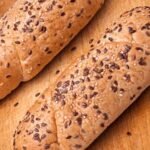
There is nothing quite like the satisfaction of pulling a perfectly crisp, audibly crackling sourdough loaf from your own oven. This recipe demystifies the process, guiding you step-by-step to create a loaf with a shatteringly crunchy crust, an airy, tender crumb, and the complex, tangy flavor that only wild yeast can provide. While the timeline is long, the active effort is minimal—it’s a lesson in the beauty of slow fermentation.
Ingredients
For the Leaven (Day 1, Morning):
-
50g active, bubbly sourdough starter
-
50g bread flour
-
50g lukewarm water
For the Final Dough (Day 1, Evening):
-
350g bread flour (high-protein, around 12-14%)
-
150g whole wheat flour (for flavor and complexity)
-
350g lukewarm water (about 90°F/32°C)
-
100g active leaven (from above)
-
10g fine sea salt
Special Equipment:
-
Digital kitchen scale (essential for accuracy)
-
Large mixing bowl
-
Bench scraper
-
Banneton (proofing basket) or a bowl lined with a floured kitchen towel
-
Dutch oven with lid
-
Razor blade or sharp lame for scoring
Method
Phase 1: Build the Leaven (Morning, Day 1)
Time: 5 minutes active | Intensity: Low
In a small jar or bowl, combine the 50g of active starter, 50g bread flour, and 50g lukewarm water. Mix thoroughly until no dry flour remains. Cover loosely and let it ferment at room temperature (70-75°F/21-24°C is ideal) for 6-8 hours. It’s ready when it’s at least doubled in size, bubbly throughout, and passes the “float test”: a small spoonful dropped into a glass of water should float.
Phase 2: Mix & Autolyse (Evening, Day 1)
Time: 15 minutes active | Intensity: Low
-
Autolyse: In your large mixing bowl, combine the 350g bread flour and 150g whole wheat flour with the 350g lukewarm water. Mix with your hands or a spatula until all the flour is hydrated and no dry patches remain. It will be a shaggy mass. Cover the bowl and let it rest (autolyse) for 45 minutes to 1 hour. This allows the flour to fully hydrate, developing gluten strength with minimal effort.
-
Mix the Dough: After the autolyse, add the 100g of active leaven to the bowl. Use wet hands to pinch and fold the leaven into the dough until it is relatively integrated—this will take 2-3 minutes. Let the dough rest, covered, for 30 minutes.
-
Add Salt: Sprinkle the 10g of salt over the dough. Add a splash of water (about 25g) to help dissolve it. Again, use wet hands to pinch and fold the salt into the dough thoroughly. It will feel wet and sloppy at first but will come together.
Phase 3: Bulk Fermentation & Coil Folds (Evening, Day 1)
Time: 4-5 hours with 5-minute intervals | Intensity: Medium
This is the crucial development phase. Keep the covered bowl at room temperature. Over the next 4-5 hours, you will perform a series of 4-6 “coil folds” spaced 30-45 minutes apart.
-
To Coil Fold: Wet your hands. Slide both hands under one side of the dough in the bowl, lift it gently until the bottom releases, and fold it over the top. Rotate the bowl a quarter turn and repeat on all four “sides.” The dough will transform from loose and sticky to remarkably smooth, strong, and aerated.
After the final fold, let the dough rest undisturbed for the remainder of the bulk fermentation. It should look visibly puffy, have increased in volume by about 30-50%, and be dotted with small bubbles on the surface.
Phase 4: Shape & Cold Proof (Night, Day 1 to Day 2)
Time: 10 minutes active, 12-16 hours inactive | Intensity: Medium
-
Pre-shape: Lightly flour your work surface. Gently turn the dough out. Using a bench scraper, shape it into a loose round. Let it rest, uncovered, for 25-30 minutes (this is the “bench rest”).
-
Final Shape: Dust the top of the dough lightly with flour and flip it over so the smooth side is down. Gently stretch the dough into a rectangle, then fold the sides into the center like an envelope. Starting from the end closest to you, roll the dough tightly into a taut boule (round) or batard (oval).
-
Proof: Generously dust your banneton (proofing basket) with a 50/50 mix of rice flour and all-purpose flour (rice flour prevents sticking). Place the dough seam-side up into the basket. Cover with a reusable bag or damp towel and place immediately into the refrigerator for a 12-16 hour cold proof. This slow fermentation builds incredible flavor and improves the crust.
Phase 5: Bake! (Day 2)
Time: 1 hour total, 5 minutes active | Intensity: High
-
Preheat: Place your Dutch oven with the lid on into the center of your oven. Preheat to 500°F (260°C) for at least 45 minutes.
-
Score: Carefully remove the hot Dutch oven. Turn your proofed dough out onto a sheet of parchment paper. Using a razor blade, score the top deeply (about ½ inch) at a 45-degree angle. This controls the expansion, creating the classic “ear.”
-
Bake: Using the parchment as a sling, lower the dough into the screaming-hot Dutch oven. Put the lid on and place it in the oven. Reduce heat to 450°F (230°C).
-
Steam & Finish: Bake covered for 25 minutes. This creates a steamy environment for maximum oven spring and crust formation. After 25 minutes, remove the lid. The loaf will be pale but risen. Bake uncovered for another 20-25 minutes, until the crust is a deep, glorious amber brown and sounds hollow when tapped on the bottom.
-
The Crucial Final Step: Resist! Place the loaf on a wire cooling rack and let it cool completely for at least 3-4 hours before slicing. The interior is still cooking and setting as it cools. Cutting too soon will result in a gummy crumb.
Nutrition Information (Per 1/12th of Loaf)
-
Calories: ~180 kcal
-
Total Fat: 0.5g
-
Saturated Fat: 0g
-
Sodium: 325mg
-
Total Carbohydrates: 38g
-
Dietary Fiber: 2g
-
Sugars: 0g
-
Protein: 6g
Note: Nutritional values are estimates based on ingredient databases. Actual values may vary slightly depending on specific flours used. This loaf is naturally low in fat and contains no added sugars.
Baker’s Notes & Troubleshooting
-
The Crunch Factor: The Dutch oven is non-negotiable for achieving a professional-level crunchy crust. It traps steam from the dough itself.
-
Timing is Fluid: Fermentation times are guidelines. Dough temperature and starter vigor are your true guides. In a warmer kitchen, everything moves faster.
-
My dough didn’t rise much: Your starter may not be active enough. Ensure it doubles reliably within 4-8 hours of feeding before baking.
-
My crust is tough, not crunchy: You may need more steam. Try spritzing the dough with water right before closing the Dutch oven lid. Also, ensure your oven is fully preheated.

Hayyat is a talented content writer and digital marketer with expertise in SEO, social media management, and online marketing. She excels at creating impactful, data-driven content to help businesses connect with their target audience and achieve measurable outcomes.