-
Prep Time: 30 minutes (active)
-
Fermentation Time: 12-14 hours (inactive)
-
Proofing Time: 3-4 hours (inactive)
-
Baking Time: 45-50 minutes
-
Total Time: 18-24 hours
-
Intensity: Intermediate
-
Yield: 1 beautiful loaf
Equipment Needed
-
Digital Kitchen Scale (essential for accuracy)
-
Large Mixing Bowl
-
Bench Scraper
-
Banneton Proofing Basket (or a bowl lined with a floured tea towel)
-
Razor Blade or Sharp Knife (Scoring)
-
Dutch Oven with a lid (highly recommended for the best crust)
-
Parchment Paper
Ingredients
| Ingredient | Weight | Baker’s Percentage |
|---|---|---|
| Mature, Active Sourdough Starter | 100 g | 20% |
| Bread Flour | 400 g | 80% |
| Whole Wheat Flour | 100 g | 20% |
| Water (room temperature, ~75°F/24°C) | 350 g | 70% |
| Fine Sea Salt | 10 g | 2% |
| Extra flour (rice flour preferred) for dusting | As needed | – |
Method
Day 1: The Leaven & Autolyse
1. Build Your Leaven (Morning, ~8:00 AM):
About 8-12 hours before you plan to mix your dough, you need to activate your starter. Take 20g of your refrigerated starter and feed it with 100g of bread flour and 100g of water. Let it sit at room temperature until it is at its peak—bubbly, domed, and roughly doubled in size. You should have about 220g of active leaven; you will use 100g for this recipe, and the rest can become your new “mother” starter.
2. Autolyse (Evening, ~7:00 PM):
In a large bowl, whisk together the 400g bread flour and 100g whole wheat flour. Add 350g of water and mix with your hands or a spatula until no dry bits of flour remain. The mixture will be shaggy and sticky. Cover the bowl and let it rest for 1 hour. This autolyse period allows the flour to fully hydrate, making the gluten development easier and resulting in a better crumb and higher rise.
Day 1: Mixing & Bulk Fermentation
3. Mix the Dough (~8:00 PM):
Add the 100g of active leaven to the autolysed dough. Use a wet hand to dimple and squeeze the leaven into the dough until it is relatively well incorporated. Let it rest for another 20-30 minutes, covered. This is called the “pinch-in” method and helps with gluten development without over-mixing.
4. Incorporate the Salt (~8:30 PM):
Sprinkle the 10g of salt over the dough. Add a tiny splash of water (about 1-2 teaspoons) to help the salt dissolve. Once again, with a wet hand, pinch and fold the dough until the salt is fully incorporated and you can no longer feel gritty bits.
5. Bulk Fermentation (~8:45 PM – ~9:00 AM next day):
This is the most critical fermentation stage. It will last for 12-14 hours at a cool room temperature (68-70°F / 20-21°C). During this time, you will perform a series of “stretch and folds” to build strength in the dough.
-
Coil Folds: Every 30 minutes for the first 2 hours, perform a set of coil folds. With wet hands, reach under one side of the dough, lift it up, and stretch it over itself. Rotate the bowl a quarter turn and repeat 3-4 more times until the dough feels tighter. You should do about 4 sets total.
-
Rest: After the final set of folds, leave the dough alone, covered, for the remainder of the bulk fermentation. It is ready when it has increased in volume by about 30-50%, is covered with a few large bubbles on the surface, and has a smooth, domed top.
Day 2: Shaping, Proofing & Baking
6. Shape the Loaf (~9:00 AM):
Lightly flour your work surface and gently turn the dough out. Be gentle to preserve the gas bubbles. Using your bench scraper and hands, shape the dough into a tight round (a “boule”) by folding the sides into the center and creating surface tension on the outside.
-
Dust your banneton generously with a mix of rice flour and all-purpose flour (rice flour prevents sticking beautifully).
-
Place the shaped dough, seam-side up, into the prepared banneton.
7. Second Proof (~9:15 AM):
Cover the banneton with a plastic bag or a damp tea towel. You have two options:
-
Room Temperature Proof: Let it proof for 3-4 hours at room temperature.
-
Cold Retardation (Recommended): Place the entire banneton in the refrigerator for 12-16 hours. This develops more complex flavor and makes the dough easier to score.
8. Pre-heat and Bake (Afternoon):
-
Place your Dutch oven, with the lid on, into your oven. Preheat to 475°F (245°C) for at least 45-60 minutes. The Dutch oven must be screaming hot.
-
When ready to bake, take your dough from the fridge. Place a piece of parchment paper over the banneton and carefully flip it over so the dough turns out onto the parchment.
-
Score the Dough: Using a razor blade, make one confident, swift slash about ½-inch deep across the top of the loaf at a 45-degree angle. This “ear” is what allows the bread to expand beautifully in the oven.
9. Bake (~12:00 PM):
-
Carefully remove the hot Dutch oven from the oven. Take off the lid.
-
Using the parchment paper as a sling, lower your dough into the hot Dutch oven.
-
Put the lid back on and place it in the oven. Bake for 25 minutes with the lid on.
-
After 25 minutes, remove the lid. The bread will be pale but well-risen. Reduce the oven temperature to 450°F (230°C).
-
Bake for another 20-25 minutes with the lid off, until the crust is a deep, golden brown and the loaf sounds hollow when tapped on the bottom.
10. Cool (CRUCIAL STEP):
-
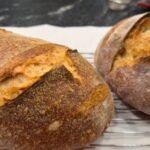
Immediately transfer the baked loaf to a wire cooling rack. You must let it cool completely for at least 4 hours, preferably 6-8. The internal starches are still setting, and cutting it warm will result in a gummy, sticky crumb. The wait is worth it!
Nutrition Information
(Per 1/12th of the loaf, approximate)
-
Calories: 170 kcal
-
Total Fat: 0.5 g
-
Saturated Fat: 0 g
-
Sodium: 325 mg
-
Total Carbohydrates: 35 g
-
Dietary Fiber: 1.5 g
-
Sugars: 0 g
-
Protein: 6 g

Hayyat is a talented content writer and digital marketer with expertise in SEO, social media management, and online marketing. She excels at creating impactful, data-driven content to help businesses connect with their target audience and achieve measurable outcomes.